Bodyboard size guide
Bodyboard size is chosen by cross-referencing your weight, your height and your level. Stood upright in front of you, tail on the ground, the board should come up to somewhere between your navel and the bottom of your sternum. In practice, that means 36 to 38″ for a child of 25 to 45 kg, 40 to 42″ for an adult of 50 to 75 kg, and 42 to 45″ above 80 kg. Bodyboards are measured in inches, from the 32″ child's board to the 46″ big-build board, and one inch is 2.54 cm.
This bodyboard size guide brings together the tables we use every day on the shop floor in Hossegor, the conversions in centimetres, and the cases that fall outside the table: big build, drop-knee, hollow waves, a growing child. It deals only with size. For the rest of the criteria, foam, level, shape and budget, everything is in our complete guide to choosing your bodyboard.
The navel method
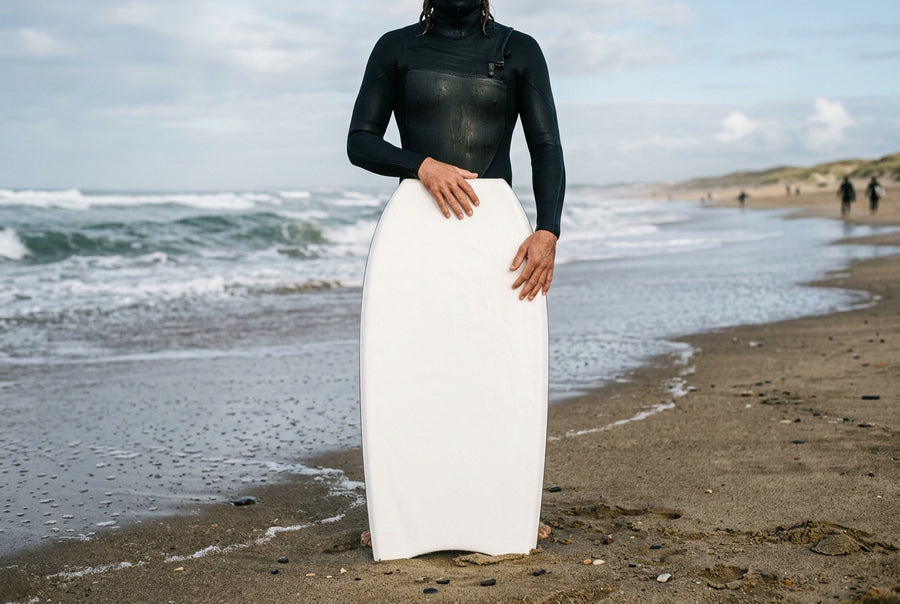
Stand the board upright in front of you, tail on the ground, and look where it stops. A board that is the right size comes up to somewhere between your navel and the bottom of your sternum. If it goes past your ribs, it is too big: you will not control it in turns and it will run away ahead of you on the take-off. If it stops below your navel, it is too small: it will not carry you enough and you will be left behind the wave.
It is not perfect, but this test rules out 80% of mistakes, and it is the first thing we get a customer to do when they walk into the shop. Its limit: it only takes your height into account. Two riders of 1.75 m weighing 65 and 90 kg do not need the same board. To settle it precisely, you need to cross-reference three parameters: weight, height and level. That is what the tables below are for.
The 10-second test
- Board upright, tail on the ground
- It comes up to between navel and sternum: right size
- It goes past the ribs: too big
- It stops below the navel: too small
| Profile | Bodyboard size |
|---|---|
| Child (25 to 45 kg) | 36 to 38″ |
| Teen or light adult (45 to 60 kg) | 38 to 40″ |
| Average adult (60 to 75 kg) | 40 to 42″ |
| Heavier adult (75 to 90 kg) | 42 to 43.5″ |
| Big build (90 kg and over) | 43.5 to 46″ |
This first table gives you the order of magnitude at a glance, by build profile. It is enough in most cases, and it matches what we say out loud in the shop when a customer asks for their size without going into more detail. To fine-tune according to your level, move on to the detailed table just below.
Bodyboard size chart by build and by level
This bodyboard size chart cross-references the three parameters that really decide: weight, height and level. The Intermediate column corresponds to a rider who can catch their wave and start their first turns. A beginner gains from taking half an inch to a full inch more than their theoretical value: the extra lift gets you onto more waves, and the number of waves caught is what makes you progress in the first months. Conversely, an expert goes down by the same amount to gain control and pivot.
| Height | Weight | Beginner | Inter. | Expert |
|---|---|---|---|---|
| 120 to 135 cm | 25 to 35 kg | 36 to 37″ | 36 to 36.5″ | 34 to 36″ |
| 135 to 150 cm | 35 to 45 kg | 37 to 38″ | 36.5 to 37.5″ | 36 to 37″ |
| 150 to 160 cm | 45 to 55 kg | 38 to 39.5″ | 38 to 39″ | 37 to 38.5″ |
| 160 to 170 cm | 55 to 65 kg | 39.5 to 41″ | 39 to 40.5″ | 38.5 to 40″ |
| 170 to 178 cm | 65 to 75 kg | 41 to 42.5″ | 40.5 to 42″ | 40 to 41.5″ |
| 178 to 185 cm | 75 to 85 kg | 42.5 to 43.5″ | 42 to 43″ | 41.5 to 42.5″ |
| 185 to 190 cm | 85 to 95 kg | 43.5 to 45″ | 43 to 44″ | 42.5 to 43.5″ |
| 190 cm and over | 95 kg and over | 45 to 46″ | 44 to 45.5″ | 43.5 to 45″ |
Calculate your bodyboard size
Weight, height and level: the range we would give you over the counter, in inches and centimetres.
Bodyboard size in cm: the conversion table
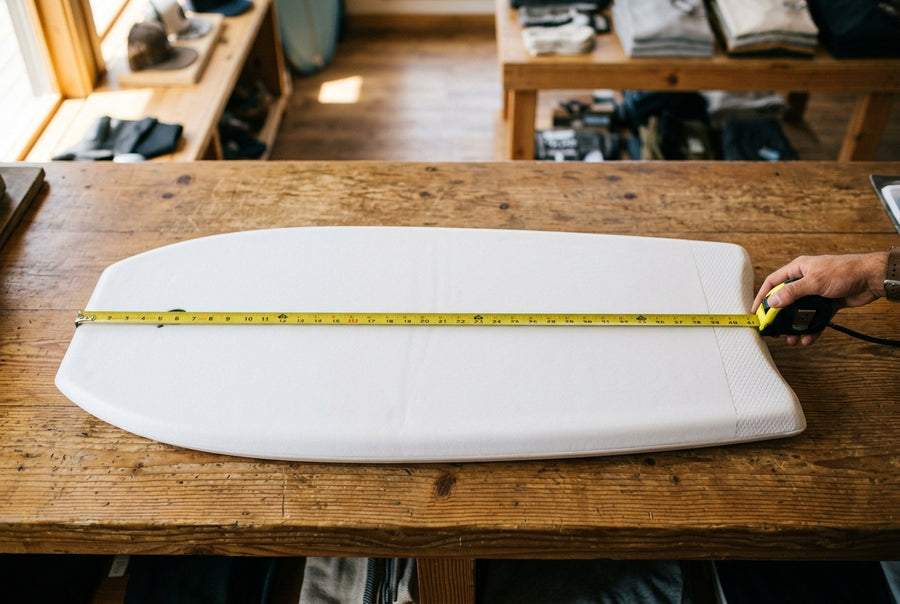
Shapers always list their boards in inches, never in centimetres. One inch is exactly 2.54 cm, which puts the adult range between roughly 91 and 117 cm. Here are the conversions for the sizes actually produced, including the half-inch sizes that make up half the catalogue.
| Inches | Centimetres | Who for |
|---|---|---|
| 34″ | 86.4 cm | Child |
| 36″ | 91.4 cm | Child |
| 38″ | 96.5 cm | Teen, light adult |
| 39″ | 99.1 cm | Light adult |
| 40″ | 101.6 cm | Average adult |
| 41″ | 104.1 cm | Average adult |
| 41.5″ | 105.4 cm | Average adult |
| 42″ | 106.7 cm | Average adult |
| 42.5″ | 108.0 cm | Heavier adult |
| 43″ | 109.2 cm | Heavier adult |
| 43.5″ | 110.5 cm | Heavier adult |
| 44″ | 111.8 cm | Big build |
| 45″ | 114.3 cm | Big build |
| 46″ | 116.8 cm | Big build |
Two sizes account for most of the sales. The 42″ is the best-selling bodyboard size for adults, because it covers the 65 to 80 kg bracket, which is the widest. The 40″ comes next for lighter builds and teens at the end of their growth. The 43″ takes over as soon as you go past 80 kg. If you are hesitating between two neighbouring sizes, for example between a 41″ and a 42″, settle it with your level rather than your weight: go up if you are a beginner, go down if you are already doing manoeuvres.
The three sizing mistakes we see most in the shop
1. Buying too big to grow into it. Choosing a bodyboard size that is too big is the number one reason for exchanges with us, and it mostly affects family purchases. An oversized board is hard to control, frustrates the child and stops progress dead. The reasoning is understandable: the child is growing, so why not plan ahead. Except that a board that is too big does not pivot under a small build, goes sideways in the whitewater and turns the session into a chore. Better the right size now, even if it means buying again in two years. The first board has only one job: to make you want to get back in the water.
2. Believing a 41″ is a 41″ everywhere. A 41″ Morey is not a 41″ Pride, which is not a 41″ NMD. Shapers do not all measure at the same point, and they do not have the same widths or thicknesses for the same length. A 41″ Morey is noticeably wider than a 41″ Pride pro model, so it has more lift, so in real volume it is closer to a competitor's 41.5″. For the same theoretical size, always compare the width and thickness shown on the product page. The figure in inches is a starting point, not a verdict.
3. Overestimating your level. In the shop, one customer in three rates themselves as intermediate when they are still a beginner, strictly speaking: fewer than twenty sessions, and no wave yet caught out at the peak. The problem is not ego, it is the consequence: they leave with a board that is too short, catch fewer waves, and conclude they are not good enough. If you are hesitating between two levels, take the lower one and add half an inch: the lift you gain is worth more than the control you imagine.

The special cases that fall outside the table
Big build, over 90 kg. Past 90 kg, the right bodyboard size is not automatically the longest one, and that is the counter-intuitive part of this bracket. Some brands make wide body shapes that are wider and thicker, such as the Pride Spartan, which add carrying volume without making the board excessively long. That pays off more than a classic 45″, which will be slow to pivot and hard work to steer in the hollow. The right reflex is to look at the volume in litres and the width before the length.
Drop-knee. If you ride drop-knee, one knee on the board and the other foot forward, go down a full inch below your theoretical prone size. The stance puts your weight on a reduced surface, and you need a compact board that pivots quickly under the knee. A board calibrated for prone will turn into a boat as soon as you get up.
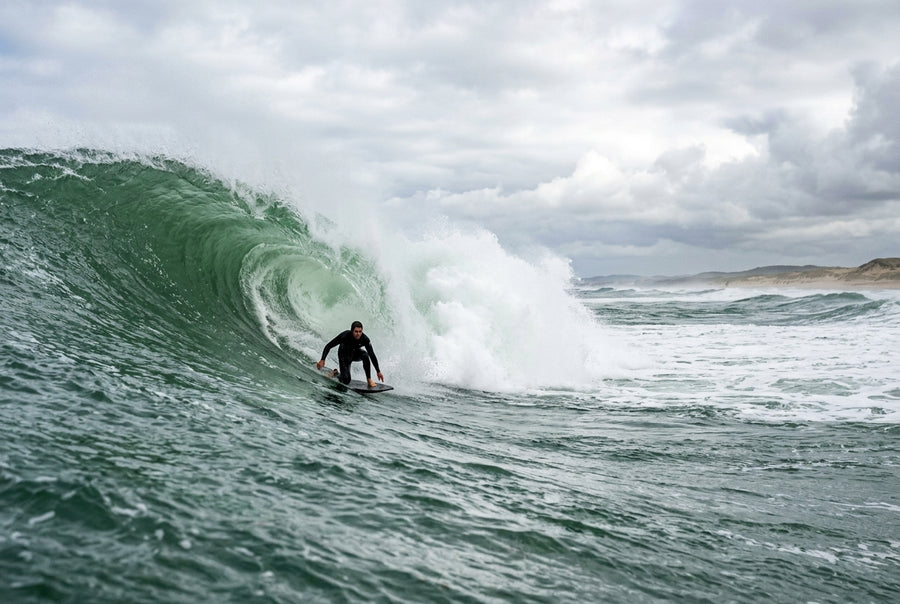
Type of wave. The spot adjusts your bodyboard size by half an inch one way or the other, once your build is settled. On hollow, powerful waves, Landes coast in autumn for instance, take off 0.5″: control comes first, the wave already provides all the speed. In the whitewater and small summer waves, add 0.5″: you need to go and find the lift that is missing. Water temperature, on the other hand, does not change your size, it changes the core that suits you, which we go into in the guide to choosing your bodyboard.
What size bodyboard for a child?
For a child, the bodyboard size sits between 33″ and 38″ depending on build, which is roughly 25 to 45 kg, and the navel test remains the best judge. The pitfalls are the same as for adults, only more pronounced. A board that is too big becomes unmanageable for a light body that does not have the strength to bring it back in line. A solid-foam supermarket board hits its ceiling after three sessions and teaches nothing.
The right indicator is the child standing next to the board, not the parent projecting the growth of the next two summers. An 8-year-old weighing 28 kg will be comfortable on a 36″ and lost on a 40″, even if they will fit the 40″ in two years' time. Allow for one board every two to three years over the growing period, that is the price of successful sessions.
FAQ, your questions about bodyboard size
How long is a bodyboard?
Adult bodyboards measure between 36″ and 46″, which is 91 to 117 cm. Children's models go down to 32 or 37″, which is 81 to 94 cm. Beyond 46″, you enter specialised shapes for very big builds, produced in small runs.
How do you choose your bodyboard size using weight alone?
Weight alone is enough to get a rough idea of your bodyboard size: take the row matching yours in the detailed table and stay in the Intermediate column. Then adjust according to your level: add 0.5 to 1″ if you are a beginner, take off 0.5 to 1″ if you are an expert. Weight is the dominant parameter, height is used to decide between two neighbouring rows.
How big is a 42-inch bodyboard?
A 42-inch bodyboard measures 106.7 cm, and it is the best-selling adult size, suited to a build of 65 to 80 kg for roughly 1.70 to 1.80 m. Be careful though: for a listed 42″, width and thickness vary from one brand to another, and so does the actual volume.
Should you go a size up when you are a beginner?
Yes. A beginner is better off going half an inch above their theoretical bodyboard size, because the extra lift gets you onto more waves. That is what we recommend in the shop for the first sessions. You will come back down a notch the day you start looking for control in manoeuvres rather than easy waves.
What size for powerful waves like Hossegor or Nazaré?
In powerful waves, go 0.5 to 1″ below your theoretical bodyboard size, with a stiff core and a reinforced stringer. In the hollow, control comes before lift: the wave provides the speed, you do not need to go looking for it.
Our recommended boards, by tier
Once you have your size in mind, there is still the core. The three foams on the market correspond to three clearly different uses, and each comes in the full range of sizes above. Here are the three boards we recommend most often in the shop, one per tier.
Entry level, PE core
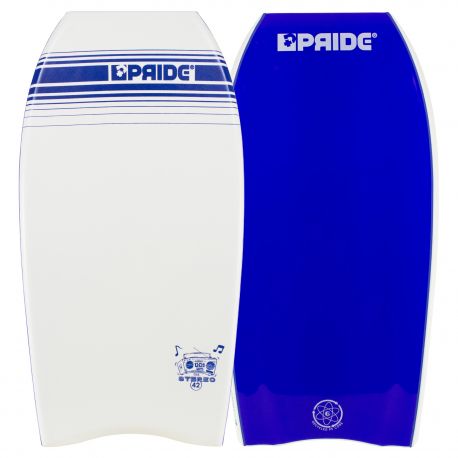
Pride Stereo recycled PE bodyboard. The PE core forgives poor positioning and glides from the whitewater onwards. The right choice to confirm your interest before investing, with a core that is at least 63% recycled. See the board
Mid-range, NRG+ core
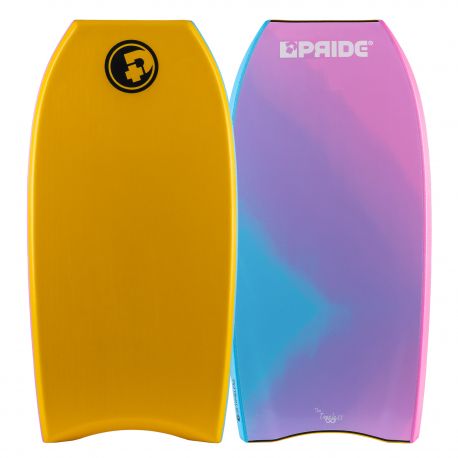
Pride Timeless NRG+ HD bodyboard. The NRG+ adds pop without becoming brittle in cold water. The board for the regular rider who goes out all year round on the Atlantic coast. See our Pride boards
Top of the range, PP core
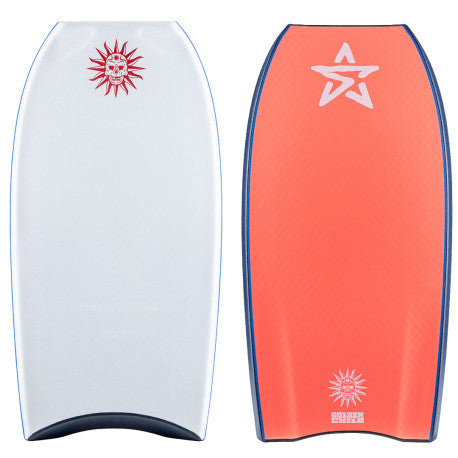
Stealth Golden Child Kinetic PP bodyboard. The PP delivers its full speed in powerful waves and holds its line in the hollow. For the advanced rider who does manoeuvres and wants an immediate response. See our Stealth boards
Completing your kit: our other guides
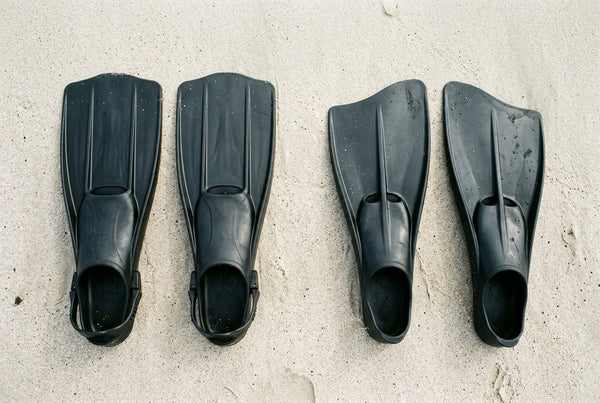
How do you choose your fins?
Symmetrical or asymmetrical, soft or stiff, the DaFin, Orca, Stealth and Vulcan size charts, and a shoe size calculator.

How do you choose your wetsuit?
Neoprene thickness by water temperature, sizing, seams and the finishes that make the difference.
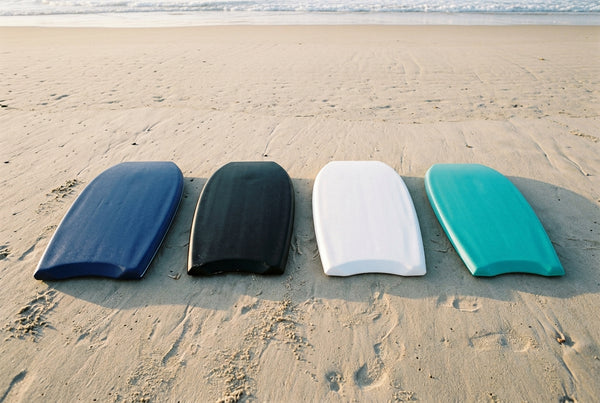
How do you choose your bodyboard?
PE, PP or NRG core, slick, stringer, shape, tail, level and budget: every criterion explained, with the brands' ranges.
You have your size, now move on to the board
Is your size in inches settled? Head to our selection of bodyboards, sorted by size and by brand (Pride, Morey, NMD, Sniper, Hubboards and the others). Filter by your size, then let the core guide you according to how you ride.
If the size is sorted but the rest is not, foam, level, shape, budget, it is all covered point by point in our complete guide to choosing your bodyboard. And if you are passing through Hossegor, come into the shop: we have almost everything in stock, and we check the size with you, board in hand, before you buy. It is still the most reliable method.
See our bodyboards