Bodyboarding for kids: how to choose the right board
Bodyboarding is often the first board sport children discover at the seaside: accessible from the very first small waves, it builds balance, confidence in the water and the joy of gliding without any pressure. But it takes the right gear. A bodyboard that is too big, too stiff or poorly equipped quickly turns a session into a struggle. This guide helps you choose a kids' bodyboard by age, height, level and conditions, with simple guidelines and a calculator.
Why choose a bodyboard designed for children
A kids' bodyboard stands out for its buoyancy, its manoeuvrability and how easy it is to kick with. The aim is for the child to be able to move forward, catch small waves, steer the board and get back to shore without tiring. With a board that is too big, they will struggle to control it, to push it under the whitewater and to position themselves correctly. With a board that is too small or too soft, they will lose lift and struggle to glide.
The right choice speeds up progress and improves safety, especially when conditions change during the session. It is also what makes them want to go back: a child who catches waves on the first day comes back the next.
What size bodyboard for a child?
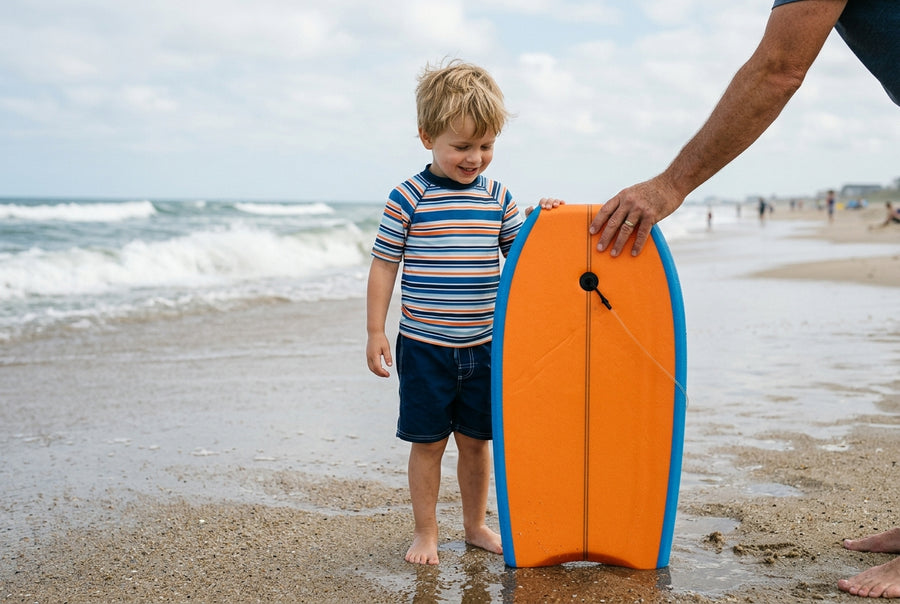
Size is the number one criterion. Stood upright in front of the child, the board should come up to between the navel and the bottom of the chest. It is the same test as for an adult, and it does not lie. Bodyboard sizes are expressed in inches: kids' boards range from 33″ to 38″ (84 to 97 cm), and the first adult sizes start at 39″.
Two nuances depending on use: a slightly bigger board helps to catch whitewater and to float; a slightly shorter board turns more easily and goes under the waves better. If hesitating between two sizes, take the smaller one if the child plays in the whitewater, the bigger one if they are starting to go for unbroken waves.
Size guidelines for a kids' bodyboard
| Child's height | Approximate weight | Bodyboard size | Equivalent |
|---|---|---|---|
| Under 120 cm | Under 25 kg | 33″ to 35″ | 84 to 89 cm |
| 120 to 135 cm | 25 to 35 kg | 36″ to 37″ | 91 to 94 cm |
| 135 to 150 cm | 35 to 45 kg | 37″ to 38″ | 94 to 97 cm |
| 150 to 160 cm | 45 to 55 kg | 38″ to 39.5″ | 97 to 100 cm, first adult sizes |
Same guidelines as our size guide: weight comes first, height decides between two sizes. Always check with the navel test.
Calculate your child's bodyboard size
Weight, height and level: the range we would give you over the counter, in inches and centimetres.
The calculator follows the table in our size guide from 25 kg and 120 cm upwards. Below that, stick to the shortest boards, from 33″ to 35″. All the detailed tables, adults included, are in the bodyboard size guide.
Materials: foam, core and skin
The material determines durability, comfort and how the board behaves in the water. Three families for children:
- Inflatable or all-EPS foam: for discovering the sport in the whitewater, with feet on the bottom, a few days a year. Light and harmless, but it does not really glide.
- EPS foam with a slick: a smooth plastic underside that makes it glide. The right compromise for regular family use.
- PE core: a real bodyboard, soft and solid, that stays with the child for several seasons once they start going for unbroken waves.
A smooth underside: essential for gliding
A kids' bodyboard should ideally have a smooth underside (the slick). All-foam models can work in very small whitewater, but quickly limit progress: they brake, do not hold a line and snap in two under a slightly powerful wave. A slick improves acceleration, direction and the feeling of glide, even in modest waves. It is the feature to prioritise if you want a board that lasts more than one season.
Stiffness and flex: finding the right compromise
A board that is too stiff needs more power and will be less comfortable for a small build. A board that is too soft deforms, loses speed and becomes hard to control. For a kids' bodyboard, aim for medium flex: soft enough to forgive and absorb, structured enough to keep gliding. Water temperature matters too: a PE core becomes stiffer in cold water and softer in warm water, which suits the Atlantic perfectly. The details on cores and stringers are in the guide to choosing your board.
The leash: a key point for safety
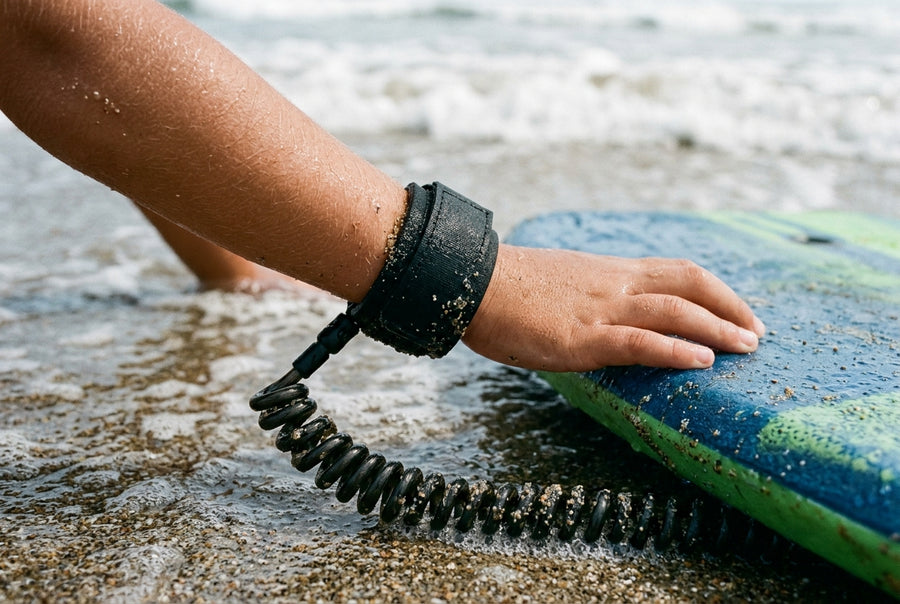
The leash stops you losing the board and reduces the risk of collisions with other bathers. For children, it is an almost compulsory accessory: the board floats, it is their best flotation aid. Check that it is suited to their size, comfortable and properly attached, and teach them to put it on before getting into the water.
The wrist leash is simple to put on and is enough in the whitewater. The bicep leash, more stable when the child picks up speed, is reserved for older kids who kick out to green waves. In all cases, make sure the velcro closes properly and the cord is in good condition.
Useful accessories for progressing
Beyond the board, a few accessories change the experience. Properly fitted fins allow better kicking, catching more waves and getting back out, but they must fit well to avoid blisters: small sizes exist from several brands, and a pair of neoprene socks often solves the sizing question. A rash vest or a wetsuit keeps the child warm and protects them from the sun and from the deck chafing their stomach. A board bag extends the life of the board by protecting it from knocks and heat.
Everything about fins, kids' sizes included, is in the guide to choosing your fins.
Avoiding premature wear
Rinse the board in fresh water after the session if possible, avoid leaving it in full sun on the sand and do not store it in a hot car: heat delaminates the materials and warps the foam. Also teach the child to carry the board rather than drag it, and to avoid rocks. These simple habits make a kids' bodyboard last several seasons.
Choosing by level and wave conditions
For a beginner who mostly plays in the whitewater, prioritise stability, buoyancy and an easy shape. As the child progresses, they will look to catch unbroken waves, to accelerate and to steer more precisely: a slightly higher-performance board, with a better core and a slick, helps them move up a level. Holiday spots with small waves call for more lift; hollower waves demand a more precise, more controllable board.
The first sessions are prepared just like for an adult, only shorter: the beginner's guide details the position on the board, getting through the whitewater and the safety rules on lifeguarded beaches.
At what age can you start bodyboarding?
Many children start around 5 or 6, as soon as they are comfortable in the water, can swim and follow instructions. Before that, a foam board with handles in 30 cm of water is a beach game, not bodyboarding. The key is to choose suitable conditions: shallow water, whitewater under 50 cm, a lifeguarded beach, an adult in the water and regular breaks. A kids' bodyboard is an excellent learning tool, because it reassures and helps them get familiar with the ocean, the currents and the timing of the waves.
Common mistakes to avoid
- Buying a board "to grow into": too big, it is a pain to manoeuvre and the child loses interest.
- Neglecting the leash, when it improves both safety and comfort.
- Choosing on price alone, without checking the slick and the overall quality.
- Fins that are too big "for next year": they come off on the first wave and hurt the foot.
- Leaving the board in the sun or in the boot of the car: the foam warps in a single afternoon.
Frequently asked questions about kids' bodyboards
At what age is it advisable to start bodyboarding?
Around 5 or 6, when the child can swim and feels comfortable in the water, in the whitewater and under supervision. Some start earlier with a foam board in a few centimetres of water, but that is a beach game. Real practice, with fins and unbroken waves, comes more like 8 to 10 years old.
How do I choose the right bodyboard for my child?
By size first: the board should come up to between the navel and the bottom of the chest, that is 33″ to 38″ depending on age. Then the material: a slick under the board as soon as the child moves beyond the whitewater, a PE core if they ride regularly. Finally a leash in their size. The table and calculator above give the exact range.
What size bodyboard for a 6, 8 or 10-year-old?
Age is a rough guide, height and weight are the real criteria. On average: around 6 (under 120 cm), a 33″ to 35″; around 8 (125 to 135 cm), a 36″ or 37″; around 10 (135 to 145 cm), a 37″ or 38″. A child who is tall or sturdy for their age takes the size up.
Inflatable or foam bodyboard for a child?
An inflatable is light, harmless and stores anywhere: perfect for discovering the sport in the whitewater, with feet on the bottom. As soon as the child wants to really glide, a foam board with a smooth underside makes the difference, and a PE core will stay with them for several seasons.
What is the difference between surfing and bodyboarding for a child?
In bodyboarding, the child stays lying on a short board that floats: no balance to find standing up, the first wave comes straight away and learning is frustration-free. Surfing requires standing up, so more strength, coordination and patience. Many children go through bodyboarding before surfing, and many stick with it. The details are in What is bodyboarding?.
Does a child need fins?
Not in the whitewater with feet on the bottom. As soon as they kick out to unbroken waves, yes, with a pair in their shoe size and fin leashes. Small sizes exist, and neoprene socks make up for a half size.
Going further: getting started, progressing, riding in winter
How to bodyboard
The beginner's guide: gear, spot, position on the board, kicking, your first wave in 6 steps, mistakes and safety.
Bodyboarding moves
From the bottom turn to the backflip: classic and advanced manoeuvres, their technique, their prerequisites and the order to learn them in.
Bodyboarding in winter
4/3 or 5/4 wetsuit, boots, gloves, hood, board and cold-water wax, session routine: ride all year round.
A board in your child's size
Our bodyboards cover kids' sizes from 33″ to 38″, with matching leash and fins. Unsure about the size: send us their height and weight and we will reply with a specific model.
See our bodyboards