

Bodyboard child: how to choose the right board for safe fun
Bodyboarding is often the first board sport that young kids discover at the beach. Easy to get started with, fun, and accessible in the first small waves, it helps build balance, confidence in the water, and the joy of riding waves without pressure. But to avoid frustration, you need the right equipment. A board that is too big, too stiff, or poorly equipped can quickly turn a session into a struggle. This guide helps you choose a child bodyboard based on age, height, skill level, and typical conditions, with simple and practical pointers.
Why choose a board designed for kids
A child bodyboard stands out for its buoyancy, maneuverability, and ease of paddling. The goal is for the child to move forward, catch small waves, steer the board, and come back to shore without getting exhausted. With a board that is too large, it becomes harder to control and to position correctly. With a board that is too small or too soft, it loses buoyancy and becomes harder to glide. The right choice improves progression and increases safety, especially when conditions change.
What size child bodyboard to choose
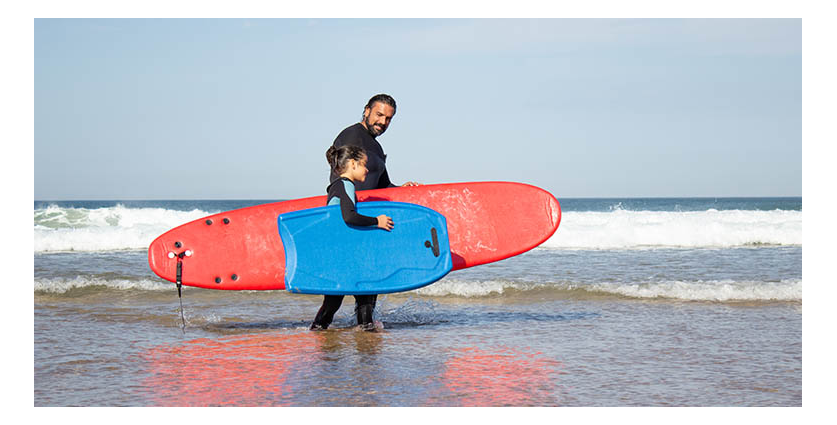
Size is the number one criterion. A bodyboard should generally reach between the belly button and the top of the hips when the child stands it upright in front of them. This creates a good balance between stability and control. In practice, you can also consider how it will be used: a slightly bigger board helps with wave catching, while a shorter board is easier to turn and manage in whitewater.
Simple size guidelines based on height
For a child around 110 to 125 cm, you will often look at short, lightweight boards. Between 125 and 145 cm, you move toward intermediate sizes that offer more glide. Above 145 cm, the child approaches teen sizing, and the dimensions become close to certain short adult boards. The best check is positioning: the child should be able to hold the board comfortably under an arm, carry it easily, and paddle without the nose sinking too much.
Materials: foam, core, and bottom
Materials affect durability, comfort, and how the board behaves in the water. For occasional family use, EPS-type foam boards are often a good fit because they are affordable and forgiving. For more regular practice, a PE or PP core offers better rebound, more durability, and better hold in waves, especially as the child improves and looks for more speed.
Slick bottom: essential for good glide
A child bodyboard should ideally have a smooth slick bottom to improve glide. Very entry-level boards made entirely of foam can work in tiny whitewater, but they quickly limit progression. A slick bottom improves speed, control, and the overall glide feeling, even in modest waves. This is a key point if you want a board that will last beyond one season.
Stiffness and flex: the right balance
A board that is too stiff will require more power and can feel less comfortable for a smaller rider. A board that is too soft can deform, lose speed, and become harder to control. For kids, a medium flex is usually best: soft enough to be forgiving and absorb bumps, firm enough to keep speed. Water temperature matters too: some foams feel stiffer in cold water and softer in warm water.
The leash: a key safety point
The leash prevents losing the board and reduces the risk of collisions. For kids, it is almost mandatory. Make sure it fits the child, feels comfortable, and is properly attached. Some setups use a wrist leash, others a biceps leash. The wrist version is easy to put on, while the biceps option can be more comfortable and stable when the child gains speed. In all cases, check the strap closes well and the cord is in good condition.
Useful accessories to progress
Along with a child bodyboard, a few accessories make sessions better. Proper fins help paddling, catching more waves, and getting back out more easily, but they need to fit well to avoid blisters. A rash guard or wetsuit helps with warmth and protects from sun and rubbing. A travel bag helps the board last longer by protecting it from impacts and heat.
Simple habits to avoid early wear
Rinse the board with fresh water after a session when possible, avoid leaving it in full sun on the sand, and do not store it in a hot car. Heat can cause delamination and deform the foam. Teach the child to carry the board instead of dragging it, and to avoid rocks. These small habits help a child bodyboard last longer.
Choose based on skill level and wave conditions
For a beginner who mostly plays in whitewater, focus on stability, buoyancy, and an easy shape. As the child improves, they will want to catch unbroken waves, build speed, and steer more precisely. A slightly more performance-oriented board with a better core and a slick bottom will help them level up. Small holiday waves often require more buoyancy, while steeper waves demand a board that is more precise and controllable.
At what age can kids start
Many children start as soon as they are comfortable in the water and can follow safety instructions. The most important thing is choosing suitable conditions: shallow water, small waves, supervision, and regular breaks. A child bodyboard is a great learning platform because it feels reassuring and helps kids understand the ocean, currents, and wave timing.
Common mistakes to avoid
The first mistake is buying a board to “grow into.” If it is too big, it will be hard to handle and the child may lose interest. The second mistake is ignoring the leash, even though it improves safety and comfort. The third mistake is choosing only based on price without checking for a slick bottom and overall build quality. A well-chosen child bodyboard makes kids want to go back in the water and supports progression over several seasons.
Summary: what to check before buying
To choose a child bodyboard, start with the right size, then check for a slick bottom, suitable flex, and a reliable leash. Also think about real usage: frequency, wave type, the child’s level, and helpful accessories. With these criteria, you get a board that is fun, safe, and progressive, so kids can fully enjoy their first glide sensations.